
The City That Wrote Itself Into the Centre of the Universe
On the mythology, the marble, and the audacity of the Royal Palace of Amsterdam.
Lars and I were on the Dam last weekend, testing Your Magical Journey -the app we’re building together that takes you through Amsterdam the way I see it (more this soon, hihihi!). We were standing right there in the middle of Dam Square, phones in hand, heads down, checking routes and timings - when I looked up.
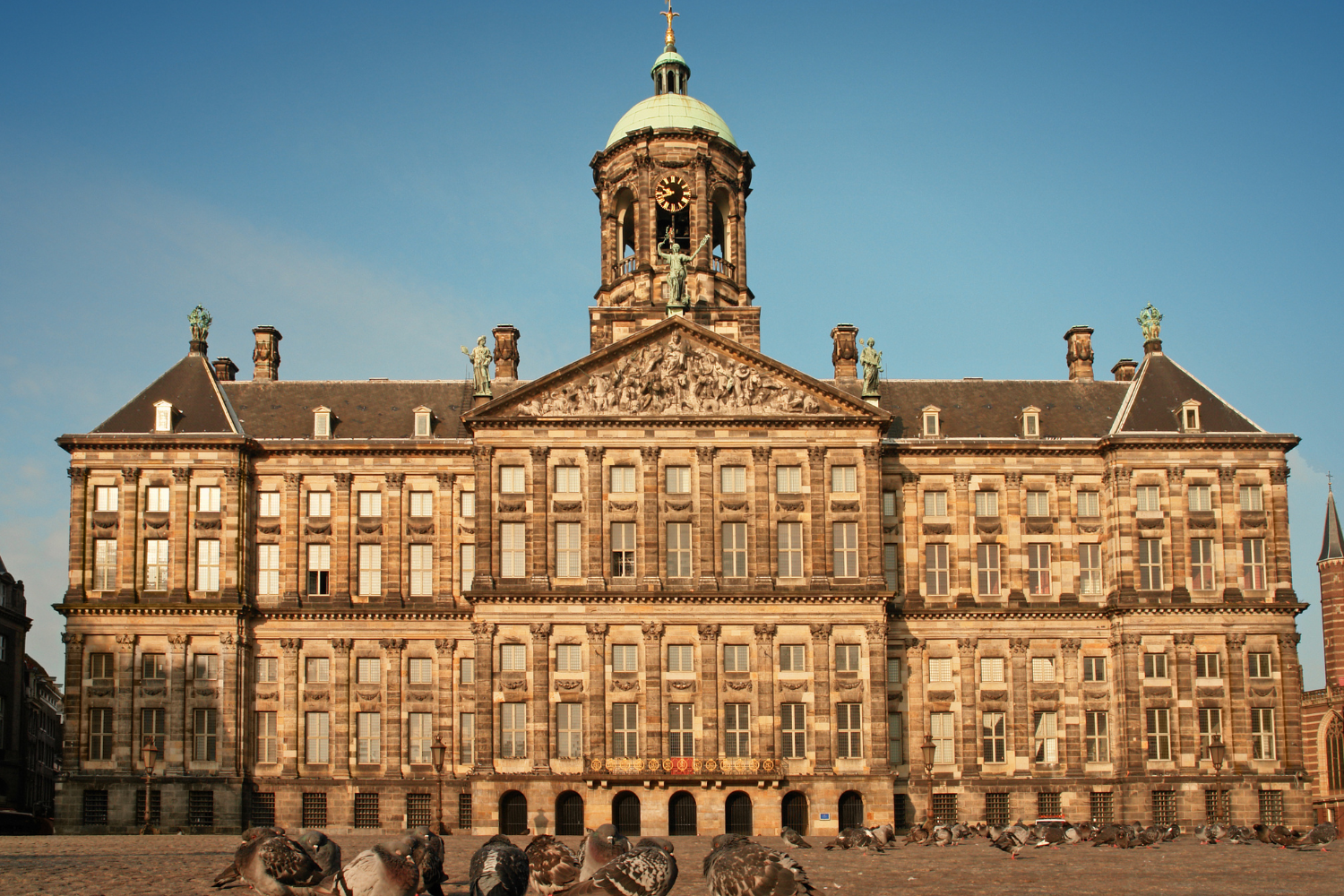
I don’t know why that particular moment. I’ve walked past the Royal Palace a hundred times. It’s always there -massive, grey-gold, impossible to miss and somehow very easy to ignore. One of those buildings that’s so big it stops being a building and just becomes the background.
But something caught me. The figures. The carvings above the entrance -marble bodies tangled together in some enormous scene I’d never once stopped to actually look at. Creatures. Gods. A woman on a throne. Things rising out of the sea.
I started googling right there on the pavement. Lars was still adjusting the app and I was pulling up Wikipedia and typing things like "Royal Palace Amsterdam tympanum mythology" with cold fingers. It wasn’t enough. There were fragments -a name here, a reference there -but nothing that told me the whole story. Nothing that explained why those figures were there, what they meant together, what kind of world they were building above my head.
So we put the phones away. Used our museum cards! (best investment guys! cost 75 Euros and we have already made up for it in two weeks!).And walked inside. What I found in there changed the way I see this building - and honestly, this city -entirely.
What’s carved above your head
The Royal Palace was never built to be a palace. It was Amsterdam’s town hall -the administrative heart of the city during the Golden Age, designed by the architect Jacob van Campen and opened in 1655. For over 150 years it was where the city governed itself. It only became a palace in 1808, when Napoleon’s(like the big French Emperor we all know!) brother Louis Bonaparte arrived in Amsterdam and decided that nothing less than the building the Dutch had nicknamed the Eighth Wonder of the World would do as his royal residence (PS. I agree with his description!).
But the mythology was there from the very beginning. Every surface of this building was designed to tell a story -and not a small one. A story about Amsterdam’s place in the cosmos (how f*ing cool!).

Stand on Dam Square and look up at the front of the palace. The enormous marble scene carved into the triangular pediment -the tympanum -is a depiction of the four world seas paying tribute to Amsterdam. Tritons ride hippocampi -half-horse, half-fish creatures from Greek mythology (yes, the one that looks like a unicorn!). Nereids, the sea nymphs, swim alongside them on dolphins and seahorses. And at the centre of it all sits the Maid of Amsterdam -the city’s own goddess, enthroned, wearing the imperial crown that was granted to the city by the Habsburg Emperor Maximilian I in 1489. She holds the city’s coat of arms on her knee. The entire ocean, every mythological creature in it, is bringing its treasures to her feet.
Above the tympanum, at the very top of the Dam-facing roof, stands Peace -a bronze goddess holding an olive branch in one hand and the caduceus of Mercury in the other. Peace and trade. Because for Amsterdam, those two things were never separate. Peace was trade. Trade was everything.
Right now it’s under reconstruction but at the back of the building, to the Nieuwezijds Voorburgwal side there is another tympanum that tells the other half of the story. The four continents -Europe, Asia, Africa, and America -bring their treasures to the Maid of Amsterdam. (Australia isn’t there. It had only just been discovered by the Dutch explorer Abel Tasman a few years earlier, and clearly hadn’t made the cut yet.) At her feet lie the river gods of the Amstel and the IJ -the two waterways that made the city possible.
And above it all, on the rooftop: Atlas. Six metres tall. Carrying a globe that weighs a thousand kilograms. The Titan from Greek mythology who was condemned by Zeus to hold the heavens on his shoulders for eternity.
He is flanked by Temperantia - Moderation, holding a set of reins, and Vigilantia -Vigilance, holding a book and a torch with a rooster at her feet.
All of this was sculpted by one man and his team: Artus Quellinus, a Flemish sculptor from Antwerp who spent nearly fifteen years turning Van Campen’s vision into stone. Every figure, every creature, every muscle and scale and wave -carved in marble by hand, in the 1650s.
I stood there looking up at Atlas and thought - this isn’t decoration. This is a declaration. These people carved their entire worldview into the front of their building and dared anyone to disagree.
The universe inside
And then you walk in. And it gets bigger.
The Citizens’ Hall -the Burgerzaal -is the beating heart of the building. Twenty-five metres high. White marble everywhere, flooded with natural light from the enormous windows. This was once the public space of the town hall, designed in the style of a Roman Forum -a place where ordinary citizens could walk in and feel the weight of their city’s story.
And here is where Jacob van Campen did something extraordinary. He designed this room as a literal model of the universe. Not a metaphor. Not a theme. A model.
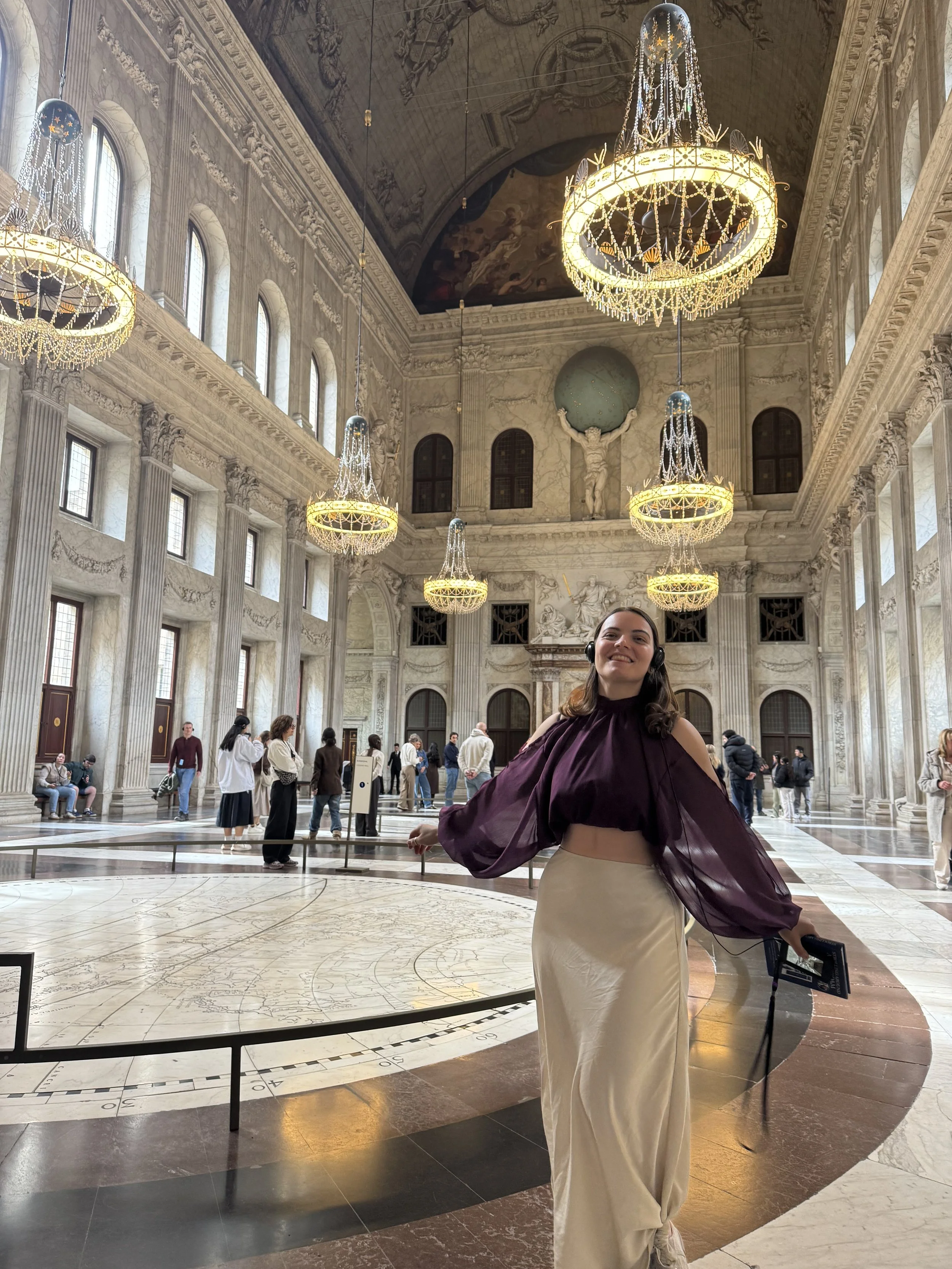
Look down at the floor. Three enormous maps are inlaid into the marble -made of black and white stone with brass detailing. Two show the hemispheres of the earth: the eastern hemisphere on one side, the western on the other. The third is a star chart of the northern sky -modelled on the celestial map published by the cartographer Willem Blaeu in 1628. Each map is over six metres in diameter. They are still the largest maps ever made. On the star map, Hercules’ club was once inlaid in metal -though the painted constellation lines have worn away over the centuries.
Then you look up. Above the archways that lead into the hall, marble reliefs depict the four elements - Earth, Water, Fire, and Air. The ingredients of all matter. Earth is a woman feeding her child, wearing a crown shaped like city walls, surrounded by animals: a dromedary, a monkey, a lion, a fox, and a snake. Each element is carved as both male and female figures, with garlands of the flora and fauna that belong to them. Together they represent the terrestrial microcosm -the small world, the world we can touch and know.
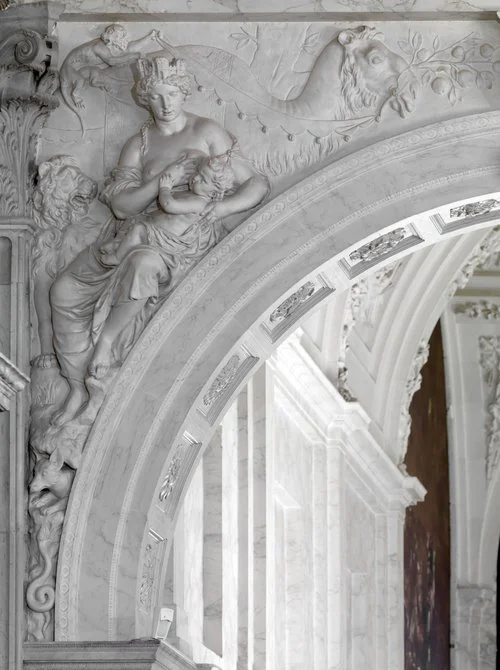
Here is Mother Earth - doing her mother earthing.
Then look into the galleries that surround the hall. In the eight corners stand marble statues of Roman gods - each one representing a planet or celestial body. Diana for the Moon. Mercury. Venus. Mars. Jupiter. Apollo for the Sun. Saturn. Cybele for the Earth. Together they form the macrocosm - the solar system, the vast cosmos beyond the world.
And at the centre of it all - enthroned above the entrance, looking out over the maps of the world and the stars at her feet -sits the Maid of Amsterdam. The three Saint Andrew’s crosses on her dress. The eagle-borne crown above her head. And on either side of her, her two guardians: Minerva, goddess of wisdom (those who know me know - me and Minerva go way back!), on her right. Hercules, the demigod of strength, on her left.
Wisdom and strength. The two forces that powered Amsterdam’s ships across every ocean on earth.
The unspoken message of this room -and it is not subtle -is: Amsterdam is the centre of the universe.
Or in other words - those who dare to create their own world (as Amsterdam was created) sit at the centre of the universe.
The details that killed me
Now don’t kill me - I had limited time! I was able to distract Lars for a good 2 hours but I was too busy wandering in awe to take any photos. I will go back for a photoshoot, so you guys can find all these sculptures! Because it’s one thing to understand the grand design. It’s another to notice the details -and the details are where this building broke open my heart.
Venus and Mars, standing in the far corner of the northwest gallery, are the only two gods in the building who look directly at each other. Not at the viewer. Not at the hall. At each other. Because Venus was married to Vulcan -but her children were with Mars, her lover. The sculptor carved a love story into the corner of a government building, and nobody needed to explain it. If you know the myth, the eye contact says everything. Venus (aka Aphrodite) was married to Vulcan (God of fire, volcanoes, and metalworking) — but she was madly in love with Mars the god of War, and theirs became the most famous love story on Olympus. The gods tried to trap them, shame them, stop them and none of it worked. They are the first mythical love story.
And then there’s Diana -goddess of the hunt, representing the Moon. In classical mythology she’s always shown with game: deer, wild boar, forest creatures. But Quellinus gave his Amsterdam Diana fish. Not stags. Fish. Because this is Amsterdam. A city born from water, built on water, fed by water. Even the goddess of the hunt has to adapt to the local reality. It’s such a small, stubborn, brilliant detail -and it tells you everything about the people who built this place. They didn’t just borrow mythology. They rewrote it. In their own image.
And at the far end of the Citizens’ Hall, facing the Maid across the length of the room: Atlas again. Carrying the heavens. Below him, a group of sculptures depicting Justice stepping on Greed and Envy -with Death, an hourglass, and instruments of torture beneath them. Above the entrance to the room where criminals once met their fate.
Every single figure in this building is placed with intention. Every myth is chosen for what it means here, in this room, for this purpose. Nothing is decorative. Everything is a sentence in a story that these people were writing in stone.
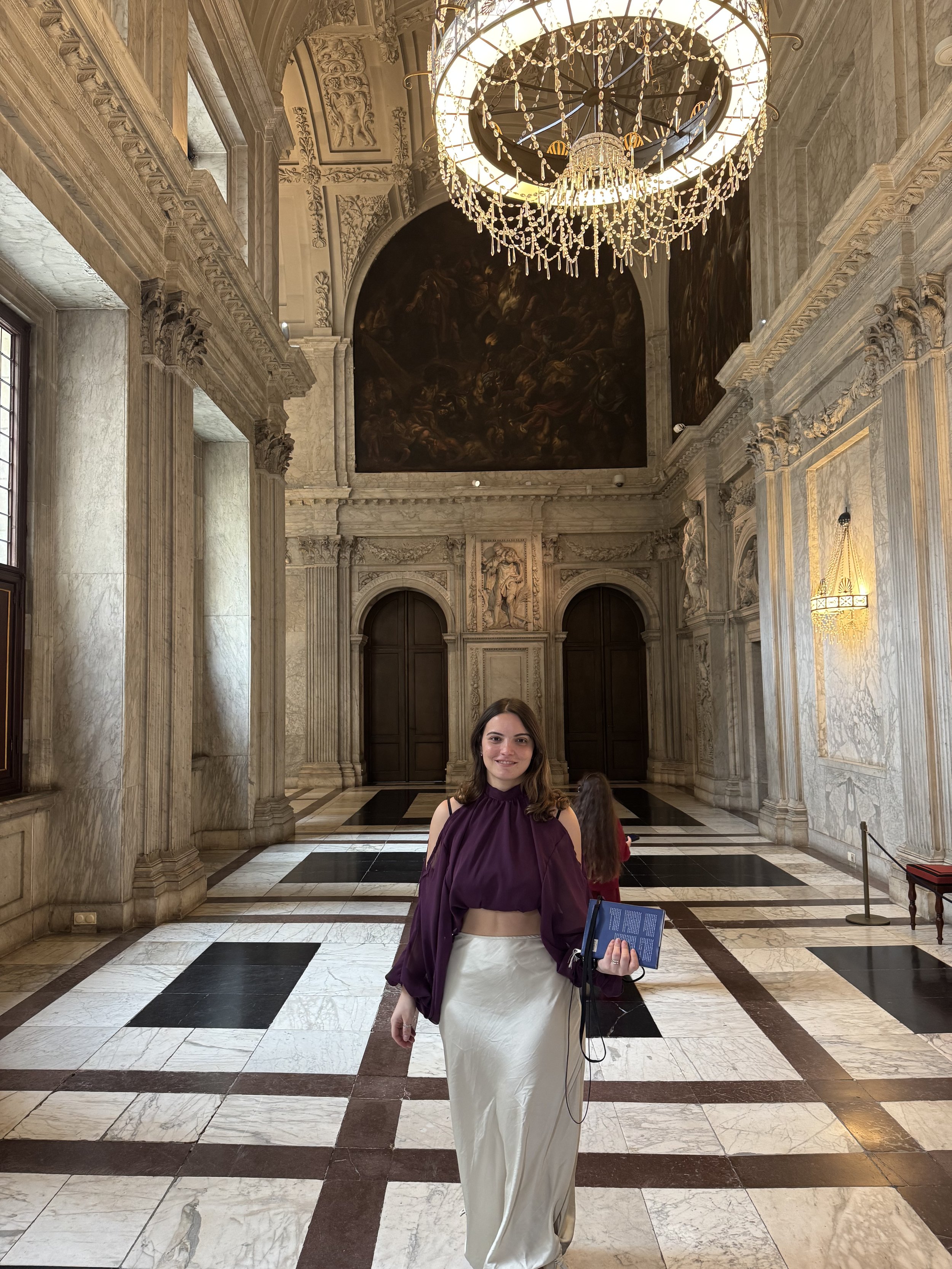
Every single figure in this building is placed with intention. Every myth is chosen for what it means here, in this room, for this purpose. Nothing is decorative. Everything is a sentence in a story that these people were writing in stone.
The audacity of it
I walked out of the Royal Palace and stood on the Dam for a long time.
What struck me wasn’t just the beauty of it. It was the nerve. The sheer, breathtaking audacity of a city that looked at itself and said: we are the centre of the universe. And then built the universe to prove it. In marble. On 13,659 wooden poles driven into the swamp.
They didn’t just govern from this building. They didn’t just hold court and count money and sentence criminals. They created a place where every citizen who walked in would feel the stars beneath their feet and the gods watching from the galleries and the entire world’s oceans bowing to their city on the wall outside. They used Greek myths and Roman gods and celestial maps and the four elements of the natural world to say: this is who we are. This is the story we are writing. And they told that story so powerfully that four centuries later, a woman and her husband can stand on the same square, look up from their phones, and get completely knocked sideways by it.
That’s what mythology does. That’s what it’s always done. It doesn’t just explain the world - it writes you into it. It gives you a role, a place, a meaning. The people who built this palace didn’t see myths as old stories about dead gods. They saw them as a language for saying the biggest, most impossible, most beautiful things about themselves. And they weren’t wrong.
I walked home through the centre of my city that evening, past the canals and the crooked houses and the people on bikes, and I thought about how many stories are carved into the surfaces of this place that I have never once stopped to read or all the stories I am actively writing today, in these streets and in these buildings.
Okay for now, I’m stopping. But it always nice to ask ourselves!
Derya x
